UN OWG Proposed Target 7.2
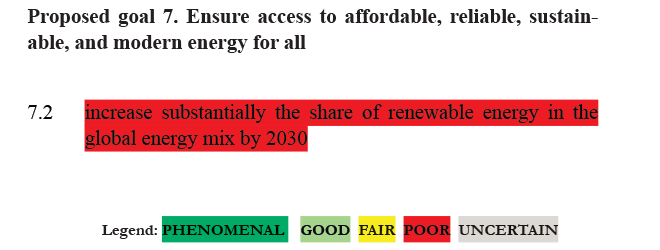
RATING: POOR – the costs to achieve this will be large and the impact on climate change will be very small, especially since total global energy consumption will increase in the future (increase in denominator).
Subsidies, and other inducements such as feed-in-tariffs (FITs) and renewable portfolio standards (RPSs), have been shown to be extremely cost ineffective and have not impacted emissions as hoped.
Krozer (2013) looks at the case of Europe’s renewables policies between 2002 and 2011 and considers benefits in terms of reductions of CO2 emissions and fossil-fuel imports. He finds that benefits have been higher than the FIT costs for on-shore wind and small hydro during periods of high oil prices. However, the costs of solar photovoltaics have been significantly higher than the benefits and slightly higher in the case of solar thermoelectric (Krozer 2013).
Del Río and Gual (2007) look at the costs of public support for the Spanish RES-E (electricity from renewable energy sources) deployment granted through the feed-in-tariff system (FIT). They find that the total RES-E support costs outweigh the external costs avoided by RES-E deployment for all technologies. (Del Río and Gual 2007).
Fundamentally, goals that target the share of renewables have potential at the local level but are limited globally. CBAs could be quite high for select regions, but globally poor without significant technological breakthroughs to deal with the intermittency and non-dispatchability of renewables
This target should be reworked as “half the share of carbon based energy in the global energy mix by 2030”. This implies a reduction of fossil fuel based energy from 82% of the current mix to 65% by 2035. This is a 20.7% decrease versus the 8.5% decrease that is currently forecast to 2035. To meet this goal, the preferred renewable options are nuclear and hydro over wind and solar, given the cost profile and poor energy reliability of the latter. However, the former options are not without consequences (such as environmental externalities), which complicate the cost and benefit assessment for the target.
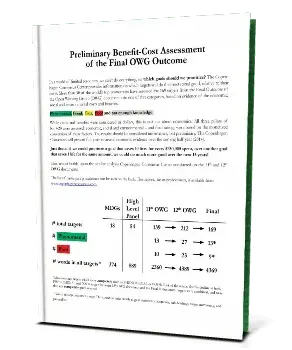
Download the entire report
In our recent report, not just the target above, but all 169 targets have been assessed by 60 teams of the world’s top economists. The targets have been categorized into five ratings based on evidence of economic, social, and environmental costs and benefits. While we applaud that the UN Open Working Group's final outcome document contains 43 fewer targets than the previous document, we are concerned that many targets have simply been combined, therefore reducing the number of both phenomenal and poor targets assessed according to our cost-benefit analysis. Our new assessment includes suggestions for how these can be improved as reported in this article by the Financial Times.