
UN OWG Proposed Target 8.3
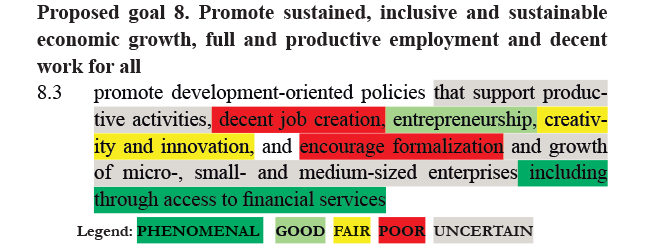
Support productive activities
RATING: UNCERTAIN As stated in 8.1 increased productivity is an important and good policy objective, though the means to obtain it are not clear. The target contains a myriad of ideas, all of which have different ratings.
Decent job creation
RATING: POOR. What is defined as ‘decent jobs’ often leads to job protection rules that favor insiders over outsiders, contribute to high rates of youth unemployment and can bias firms choice of optimal size and increase poverty, as has been shown in the case of India (Besley and Burgess, 2014).
Entrepreneurship
RATING: GOOD – it is important to foster an environment for entrepreneurship – one in which individuals have access to capital and are rewarded for taking risks. Expanding opportunities for entrepreneurship is particularly important in the developing world where it has not just economic, but social benefits (life satisfaction, upward mobility).
Creativity and innovation
RATING: FAIR Maskus (2014) shows that raising R&D for developing and emerging economies beyond current trends through government expenditure or R&D credits will produce benefit-cost ratios in the FAIR range and even then, only between 1 to 2. Such countries would be better advised to invest in human capital and governance to establish solid frameworks within which knowledge spillovers from access to international technologies are optimized.
Formalization of enterprises
RATING: POOR Evidence shows that formalization of employment and enterprises does not necessarily confer benefits. Recent studies have found that the informal firms that have been induced to become formal by various interventions that subsidize the costs of formalizing have experienced little benefit on average from doing so (Bruhn and McKenzie, 2013). While the formalization of employment can confer advantages on a lucky few, the rigidities in labor markets that may be created act to reduce overall labor demand at the expense of the many.
Growth of enterprises
RATING: UNCERTAIN. There have been randomized controlled trials that suggest certain interventions such as providing early stage risk capital, and improving basic skilling have high benefits, relative to costs. Evidence is not clear enough to provide more confident recommendation.
Access to financial services
RATING: PHENOMENAL – access to credit for small scale producers is very important. It encourages entrepreneurship and allows businesses to expand. This is a key target that is likely to yield economic and social benefits.
Download the entire report
In our recent report, not just the target above, but all 169 targets have been assessed by 60 teams of the world’s top economists. The targets have been categorized into five ratings based on evidence of economic, social, and environmental costs and benefits. While we applaud that the UN Open Working Group's final outcome document contains 43 fewer targets than the previous document, we are concerned that many targets have simply been combined, therefore reducing the number of both phenomenal and poor targets assessed according to our cost-benefit analysis. Our new assessment includes suggestions for how these can be improved as reported in this article by the Financial Times.